
Marceau Couve
b. 1978
Contemporary Fine Arts
Lives and works in Limogne-en-Quercy, France
Painting
Photography
Music
Projects
About
I studied at the École Supérieure de l'Image in Angoulême, then completed my DNSEP at ISDAT Toulouse under Katarina Schmitt, with a semester at ABK Stuttgart in Alexander Roob's class.
My paintings have been shown widely across France and Germany, including at the Ludwig Museum (Koblenz) for the group exhibition Malerei 2020, and the L.A.C. (Sigean). Solo exhibitions include Ganymed at Ringstube (Mainz) and Age of Wonders at Westpol (Leipzig), where I also took part in the group show Das Paradies ist nebenan.
For Estonia's centenary, I created and co-directed Pollen EV100, a nationwide public commission that dressed the country's statues in gigantic hand-knitted scarves and hats, styled in Estonia's national colours.
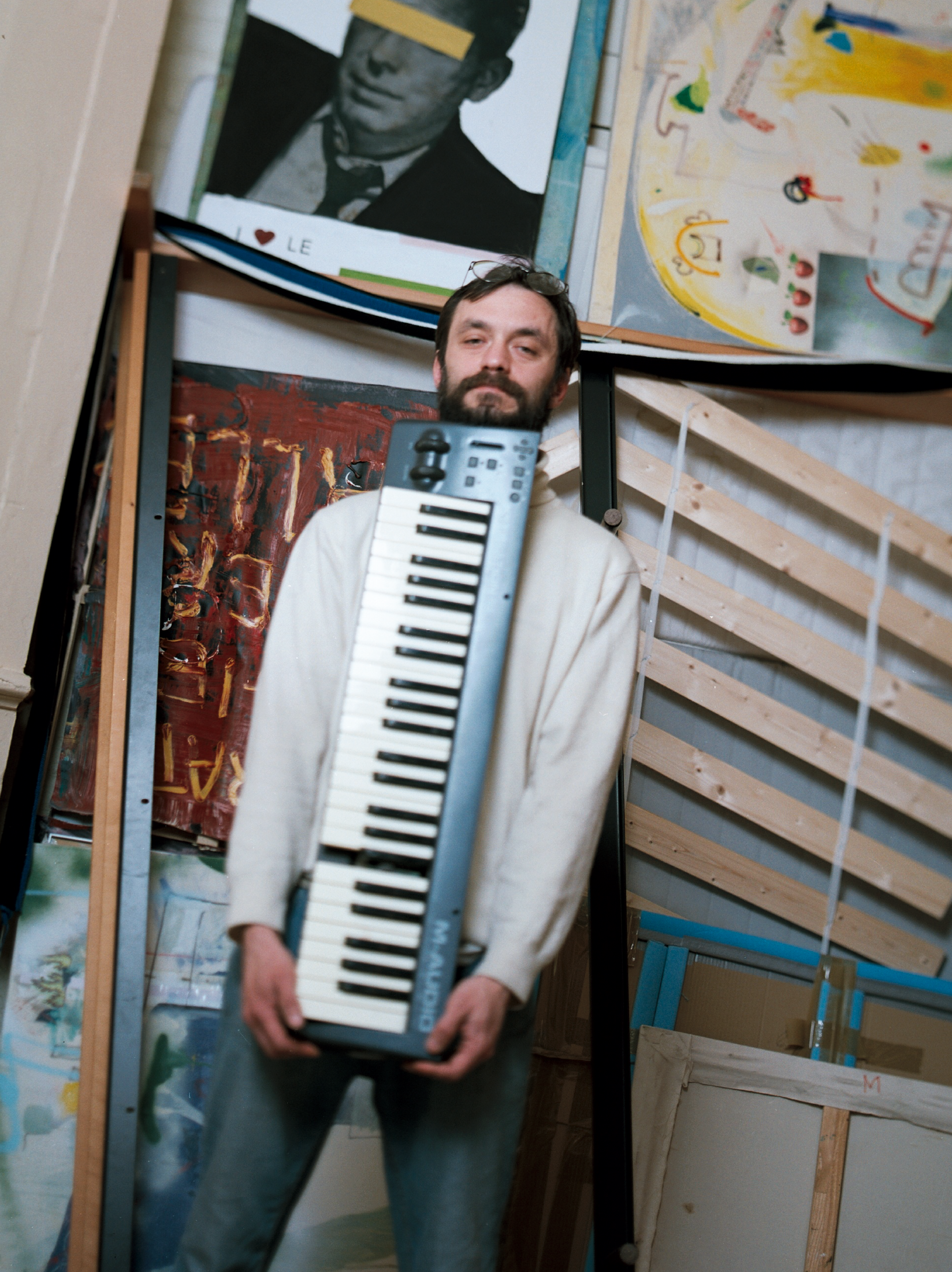
Alongside my studio practice, I compose pop music and shoot medium-format film portraits. I have also curated an ignorant-style street art collection in Estonia, documented in the publication Toy Awareness in Estonia, and I am currently working on a theoretical project that ties these threads together.
I live and work in Limogne-en-Quercy, a small village in Occitanie, but my practice moves within a European triangle, with strong collaborative ties to Leipzig and Tallinn.
Toy Awareness in Estonia
Photographic selection of graffiti interventions by so-called Toys in Estonia.
In graffiti culture, a "Toy" refers to a writer considered inexperienced, unskilled, or unsuccessful according to the internal standards of the scene. Their work is usually dismissed or ignored in favor of that produced by the "Kings," writers recognized for technical control and stylistic mastery. This collection uses these terms strictly as a frame of reference.
The images were collected across Estonia between 2020 and 2022 and selected from a wider field of observation. They focus on isolated interventions within the urban environment, where graffiti appears in its most immediate and unstable form.
Crude drawings, emojis, improvised symbols, names, insults, and fragments of speech accumulate across surfaces. Together they form an informal visual language, inconsistent and unregulated. At the margins of codified graffiti practices, these marks produce a parallel and fragmented visual field.
Within the scene, Toys are defined by lack of experience or technical skill, and by distance from its conventions. Whether through inexperience or indifference, their interventions introduce unpredictability into a practice otherwise governed by strong internal codes.
Seen as a whole, these images suggest an urban adolescent poetry: transgressive, playful, punk, absurd, often unintentionally humorous. They appear without concern for recognition or legitimacy. Each intervention functions as a fragment within a broader and unstable urban system.
The project began in 2020 and was completed in 2022 with the help of my friend Karin, who provided thousands of photographs that made this selection possible.
These images resonate at times with Art Brut, primitivism, and naïve painting, not as references but as echoes: forms defined by immediacy, lack of refinement, and resistance to formal codes. They point to visual expression produced outside intention, through accident, misuse, and disregard.
Marceau Couve
Pollen EV100
In 2018, for Estonia's centenary celebrations, I conceived and initiated a public art project in collaboration with the Estonian architecture collective KAOS. As the original author of the idea and the project's manager, I proposed placing blue, black, and white scarves and hats on statues in public spaces across the country. The gesture was intended to make Estonian identity visible in an extremely direct, simple, and almost naïve way. By dressing familiar monuments in the colors of the national flag, the project playfully engaged with the imagery of the national narrative, transforming public space into an accessible and immediate expression of national belonging.
Le Dit de Paul
Loading the book…